"All, too, will bear in mind this sacred principle, that though the will of the majority is in all cases to prevail, that will to be rightful must be reasonable; that the minority possess their equal rights, which equal law must protect, and to violate would be oppression."

-- Thomas Jefferson, First Inaugural Address, 1801


TomHoefling.com

J.D. Ellis,
Vice Presidential Nominee,
America's Party

Conservative voters don't vote for liberal politicians. Both Barack Obama and Mitt Romney are liberal politicians. As Mr. Hoefling has said many times, Republicans may be conservatives, or they may support Mitt Romney--but they may not do both.

Principled patriotic American voters don't vote for candidates who are opposed to America's foundational principles. Both Barack Obama and Mitt Romney hold a number of positions that are directly opposed to America's foundational principles. Republicans may be principled patriotic Americans, or they may support Mitt Romney--they may not do both.

Pro-life voters don't vote for pro-abortion candidates. Both Barack Obama and Mitt Romney are pro-abortion candidates. Republicans may be pro-life, or they may support Mitt Romney--they may not do both.

With the impending Republican nomination of Mitt Romney for president, it is becoming increasingly difficult to deny that patriotic, pro-life conservatives are no longer allowed any real voice in the Republican Party. But patriotic, pro-life, conservative Republicans are welcome in America's Party.

http://www.selfgovernment.us/affiliate.html


"Still, if you will not fight for the right when you can easily win without bloodshed, if you will not fight when your victory will be sure and not so costly, you may come to the moment when you will have to fight with all the odds against you and only a precarious chance for survival. There may be a worse case. You may have to fight when there is no chance of victory, because it is better to perish than to live as slaves."

-- Winston Churchill


"The God who gave us life gave us liberty at the same time; the hand of force may destroy, but cannot disjoin them."

-- Thomas Jefferson, Rights of British America, 1774


Alan Keyes counters 'religious freedom' claim regarding contraceptive mandate

WorldNetDaily.com

Alan Keyes

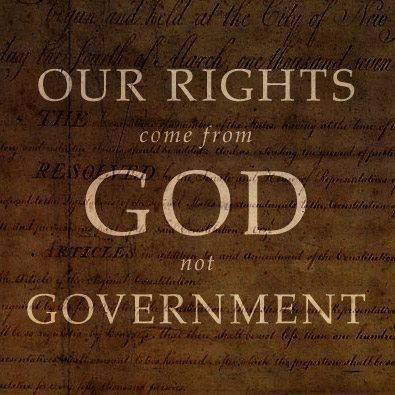
In my WND column last Friday, I pointed out that “every assertion of a fundamental human right necessarily relies in turn upon an assertion about what is right.” Today this fact is more often than not ignored, even by Americans who profess to be ardent defenders of the liberty America’s founders intended to establish and preserve. Madison succinctly summarized the founders’ understanding when he said that “Justice is the end of government, it is the end of civil society. …” But the Declaration of Independence makes clear that the end or aim of the institution of government is to secure God-endowed unalienable rights. (“To secure these rights governments are instituted among men. …”) Justice is thus identified with the security (safe existence) of unalienable rights, because both are identified as the singular end or aim of government. (If A=C and B=C, then A=B.)

This appears even more plainly when we recall that the root of justice (Latin “iustus”) is right (Latin “ius” or “ious”). But in the context of the Declaration’s stated purpose for government, God endows right (i.e., He provides the “income” that establishes it; He determines what goes into it; He is the source of its conceptual substance or meaning). In the Declaration America’s founders declare that the colonies “are, and of right ought to be free and independent States. …” Their free condition is thus identified as a matter or right, a consequence of the substance or meaning which God endows their nature. By invoking their natural right they invoke the authority of the Creator, which is its source and substantiation.

Since the founders’ assertion of freedom invokes the authority of the Creator, the validity of the assertion depends on its conformity with the substance or meaning of right established by that authority. But this dependency has a consequence. It restricts the assertion of freedom within boundaries determined by this conformity to God-endowed right. Freedom is therefore not an unlimited potential for action. The assertion of freedom is valid only for action in conformity with the substance or meaning of right as established (endowed) by the Creator.

By this straightforward logic Abraham Lincoln was bound to conclude that one cannot have the right to do what is wrong. If it is wrong, for instance, to murder innocent people, one cannot claim to do so as a matter of right. If it is wrong, by enslaving them, to violate their God-endowed liberty, one cannot claim to do so as a matter of right.

Read this story at wnd.com ...


"Human nature itself is evermore an advocate for liberty. There is also in human nature a resentment of injury, and indignation against wrong. A love of truth and a veneration of virtue. These amiable passions, are the "latent spark"... If the people are capable of understanding, seeing and feeling the differences between true and false, right and wrong, virtue and vice, to what better principle can the friends of mankind apply than to the sense of this difference?"

-- John Adams, the Novanglus, 1775


_"The propitious smiles of Heaven can never be expected on a nation that disregards the eternal rules of order and right, which Heaven itself has ordained."

-- George Washington, 1789


__"Do the right thing. It will gratify some people and astonish the rest."

-- Mark Twain


_“Right is Right even if nobody does it. Wrong is wrong even if everybody is wrong about it.”

― G.K. Chesterton